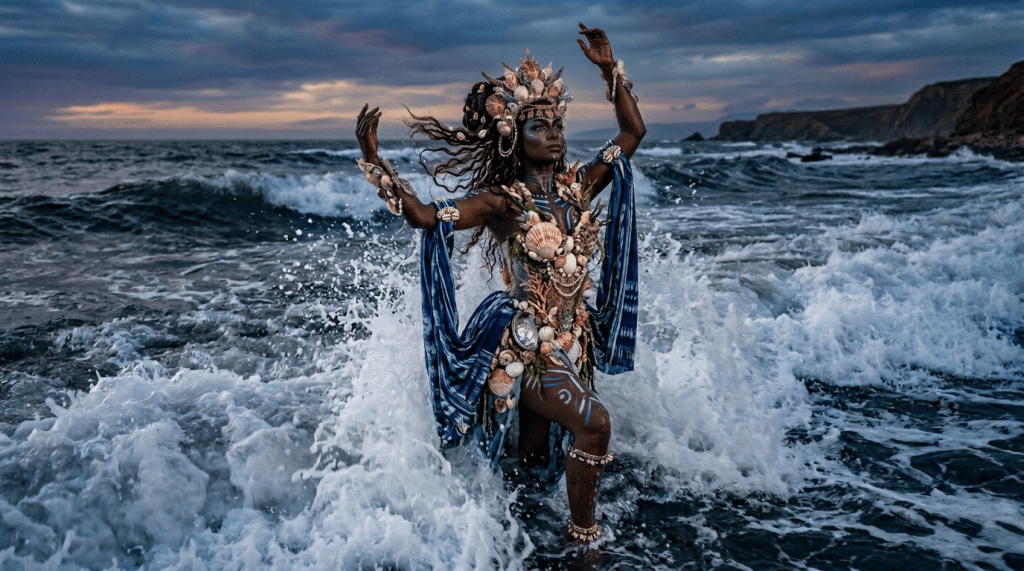
Yemoja is one of the most widely venerated deities in Yoruba religion, honored as a goddess of rivers, seas, motherhood, and fertility. Her name comes from the Yoruba phrase Yeye Omo Eja, meaning “Mother whose children are the fish,” a title that captures both her nurturing character and her deep connection to water. Originally tied to the Ogun River in southwestern Nigeria, her worship expanded across the Atlantic during the slave trade and now spans Santería, Candomblé, and other Afro-diasporic traditions. Few Yoruba deities carry as much symbolic weight as the figure often called the mother of all orishas.
Yemoja’s staying power comes from how directly she speaks to universal experiences of motherhood, protection, and the life-sustaining power of water. She offered Yoruba communities a goddess whose domain touched something as essential as survival itself, and that same resonance helped her worship endure the trauma of the transatlantic slave trade and take root in new forms across Cuba, Brazil, and beyond. Millions of devotees today still honor her through festivals, offerings, and rituals tied to rivers and the sea. Readers curious about how she became one of the most recognized orishas in the African diaspora may want to look further into her transformation into Yemanjá and Yemayá in Brazilian and Cuban tradition.
Yemoja belongs to the Yoruba pantheon of orishas, spirits who mediate between humanity and Olodumare, the supreme creator. In Yoruba belief she is celebrated as the metaphysical mother of all orisha and the giver of life, a status that sets her apart even among a pantheon that traditional accounts describe as numbering in the hundreds. Her original domain centered on the Ogun River, but as her worship spread her influence grew to cover oceans and bodies of water more broadly, along with childbirth, protection of women and children, and the wellbeing of families.
Yoruba oral tradition includes several stories about Yemoja’s role in creation and her relationships with other orishas, though details vary by region and source. Some accounts describe her assisting Obatala in shaping humanity, while others focus on her as a source from which other deities and rivers were born. One frequently told story involves conflict with a child who threatened her, forcing her to flee, a narrative that shows up in different forms across Yoruba, Cuban, and Brazilian retellings. This kind of variation is typical of orisha mythology, since these traditions passed down orally for centuries and diverged as communities carried them into new regions. When enslaved Yoruba people were transported to the Americas, they carried Yemoja’s worship with them, and she reemerged as Yemanjá in Brazil and Yemayá in Cuba, often blended in devotees’ practice with the Virgin Mary.
Yemoja’s symbolism centers on water, motherhood, and abundance, expressed through a set of colors, objects, and animals that recur across Yoruba and diasporic traditions alike. Shrines and festivals dedicated to her draw on this shared visual language, which has stayed remarkably consistent even as her worship spread across continents.
Common Symbols
- Seashells, fishnets, and miniature boats: These objects reference her domain over the sea and appear frequently on altars dedicated to her.
- Fountains and blue-and-white crockery: Devotees often decorate her altars with fountains alongside blue and white dishware, echoing the colors of water.
- The number seven: Sacred to Yemoja, the number is linked to the seven seas, and devotees sometimes wear seven silver bracelets in her honor.
Sacred Animals
Fish hold particular significance given the literal meaning of her name, and she is closely tied to marine life more broadly. In some traditions she is depicted as a mermaid, reinforcing her identity as a being at home in the water rather than fully separate from it.
Colors
Blue and white are consistently associated with Yemoja, symbolizing water and purity. Devotees frequently wear layered blue-and-white skirts during festivals and rituals honoring her.
Celestial Associations
Some sources connect Yemoja to the moon, tying her to the tides and to broader ideas about feminine and cyclical power, though this association appears less uniformly across sources than her ties to water itself.
Yemoja’s place in the Yoruba family of orishas is described differently depending on the tradition, which is common for deities whose stories passed down through oral transmission across centuries and regions. Many accounts identify her as a daughter of Obatala, the orisha of purity and wisdom, who also appears in some traditions as her consort. Other sources instead present her simply as one of the primordial female orishas, without a fixed set of parents.
Her role as mother is the most consistent thread running through her mythology, even when the specifics shift. She is frequently described as the mother of Oshun, the river goddess associated with love and abundance, and various accounts connect her to other prominent orishas as well, including Shango and Ogun. Some traditions describe a difficult relationship with a son who eventually threatened her safety, forcing her into flight, a story that varies in detail but consistently reinforces her identity as a protective yet vulnerable maternal figure. Because of the sheer number of orishas she is said to have given rise to, Yemoja often functions less as a deity with a fixed family tree and more as the root from which the wider Yoruba pantheon is imagined to have grown.
 LOVE + TEA + SOUL