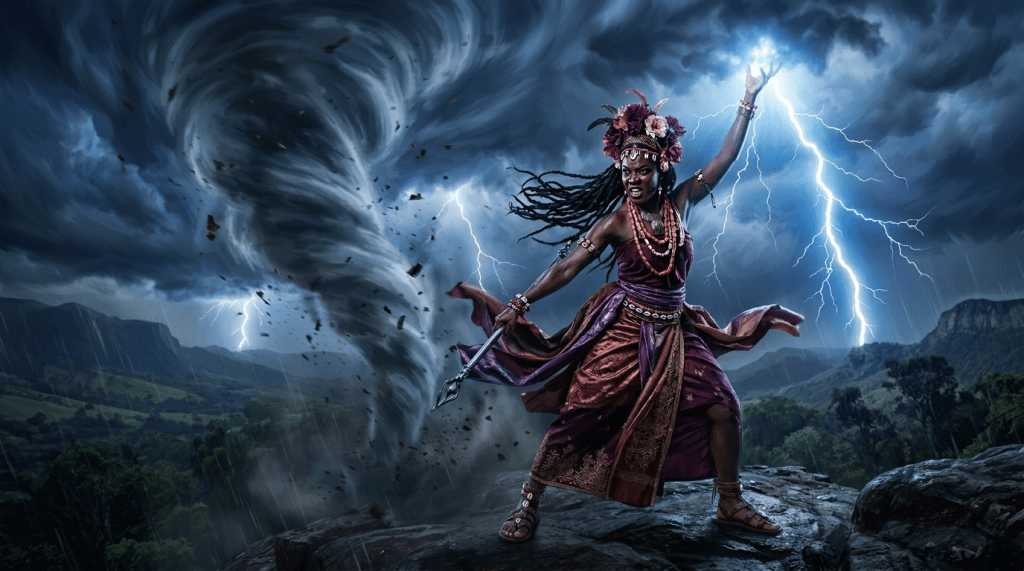
Oya is the Yoruba orisha of wind, storms, and sudden change, a deity whose temperament mirrors the weather she commands. She belongs to the same pantheon of orishas as Oshun and Yemoja, serving as an intermediary between humans and the supreme creator, Olodumare. Beyond Nigeria, her worship crossed the Atlantic through the slave trade and took root in Cuba, Brazil, and Haiti, where she is still honored today. Few deities carry as much raw force in their portfolio, since Oya governs not just weather but the passage between life and death itself.
Oya endures because her mythology refuses to separate destruction from renewal, treating both as part of the same natural process. She gives worshippers a way to understand upheaval, whether a literal storm or a personal crisis, as something that clears space for what comes next rather than as pure loss. That framework, paired with her role guarding the threshold between the living and the dead, gave her worship a resilience that carried across oceans and centuries of forced displacement. Millions today still honor her from Nigeria to Havana to Salvador, often precisely because life keeps handing people the kind of change only Oya seems built to explain. Readers curious about how she balances Shango’s fire with her own wind may want to look further into the myths surrounding their turbulent marriage.
Oya originated among the Yoruba people of southwestern Nigeria, where she is closely tied to the Niger River, known locally as the Odo-Oya. Her domain covers wind, lightning, tornadoes, and the kind of upheaval that clears out what no longer serves a purpose, whether that means a storm leveling a field or a sudden shift in someone’s fortunes. She is also recognized as a guardian of marketplaces, spaces defined by constant exchange and flux, and as the deity who watches over the boundary separating the living from the dead. In Nigeria, she plays a central role in the Egungun festival, a tradition honoring ancestral spirits, reflecting her deep connection to the world of the departed.
Her most retold myth concerns her marriage to Shango, the orisha of thunder, a union so charged that Yoruba tradition often treats it as the meeting point of two elemental forces: his lightning and her wind. Some accounts describe her as originally unable to bear children, until she offered a rainbow-colored cloth as sacrifice and was rewarded with nine, a story behind her praise name Iyansan, meaning “mother of nine.” That worship endured the Middle Passage largely intact, and today Oya appears under related names, including Iansã in Brazilian Candomblé, where devotees still gather each February to honor her.
Oya’s imagery draws on the unpredictability of wind and the finality of death, giving her one of the more distinctive visual profiles among the orishas. Priests and devotees rely on a consistent set of objects and colors across Yoruba, Cuban, and Brazilian traditions, even as the details of ritual practice shift from region to region.
Common Symbols
- The horsetail whisk: Carried as a tool of both cleansing and battle, the whisk is said to sweep away obstacles and negative energy in Oya’s path.
- The machete or sword: A reference to her role as a warrior, sometimes shown paired with a second blade to emphasize her fighting skill.
- Nine skirts or nine pleats of cloth: Tied to her identity as mother of nine, this detail recurs often enough in her depictions to function as a kind of signature.
Sacred Animals
The buffalo is closely associated with Oya, appearing in stories where she takes buffalo form or channels its strength and horns into battle. This connection reflects her reputation as an unbeatable warrior who fights alongside, and sometimes ahead of, the male orishas.
Colors
Maroon, burgundy, and deep wine tones are widely associated with Oya, along with patterns of nine colors combined in her ceremonial cloth, a nod to her praise name.
Celestial Associations
Oya’s power is tied more to atmospheric phenomena, wind, lightning, and storm fronts, than to fixed points in the sky, and Yoruba sources do not assign her a specific star or planet the way some other deities receive.
Accounts of Oya’s parentage vary, but many traditions describe her as a daughter of Yemoja, the orisha of the ocean, linking her to the wider family of water deities alongside Oshun. This lineage places three of the most prominent female orishas, Yemoja, Oya, and Oshun, within an interconnected web of river and sea worship that spans Yoruba religion and its diasporic offshoots.
Her marriage to Shango forms the backbone of her mythology, and some traditions place her alongside Oya, Oba, and Oshun as his wives, a household defined as much by rivalry as affection depending on which version of the story is being told. She is remembered as the mother of nine children, often interpreted as the nine tributaries or spirits of the Niger River rather than as individually named offspring. Her connection to Ogun, the orisha of iron and war, appears in stories that highlight her own combat skill and her comfort operating in traditionally male domains of Yoruba religious life.
 LOVE + TEA + SOUL