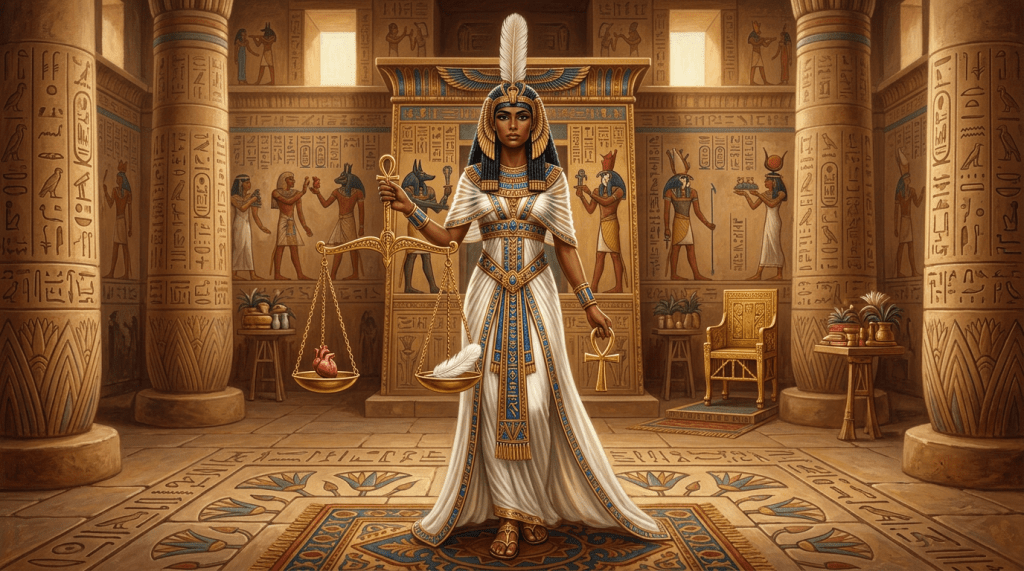
Ma’at was the ancient Egyptian personification of truth, balance, and justice, and she stood at the center of how Egyptians understood their entire world. Egyptians believed she governed everything from the movement of the stars to the fairness of a local trial. Pharaohs claimed to rule in her name, priests invoked her in temple rituals, and ordinary people hoped their actions would align with her principles before they died. Her influence stretched across three thousand years of Egyptian civilization, making her one of the most enduring ideas in the ancient world.
Ma’at offers a window into how ancient Egyptians linked morality, cosmic stability, and daily life into a single system. She gave ancient Egyptians a way to connect the movement of the cosmos to the conduct of a single human life, treating truth and justice as forces as real and necessary as gravity or sunlight. Her presence in royal ideology, legal proceedings, and funerary belief shows how thoroughly the concept shaped Egyptian civilization for millennia.
Ma’at emerged early in Egyptian religious thought, likely during the Old Kingdom, and she represented far more than a single deity among many. She embodied the underlying order of the universe: the predictable rising of the sun, the flooding of the Nile, the rhythm of the seasons, and the moral conduct expected of every person. Pharaohs were described as upholding Ma’at through just rule, and viziers and judges invoked her when settling disputes. Her opposite was isfet, a term covering chaos, falsehood, and injustice. Egyptian religion framed daily life as an ongoing effort to hold isfet at bay.
Her most famous role appears in funerary texts, particularly the Book of the Dead. There, the heart of a deceased person was weighed against Ma’at’s feather in the Hall of Judgment, overseen by Osiris and the jackal-headed god Anubis. A heart heavier than the feather, weighed down by wrongdoing, meant the soul would be devoured by the monster Ammit and denied an afterlife. A heart that balanced evenly with the feather allowed the deceased to pass into the fields of paradise. This ritual made Ma’at central to Egyptian ethics, since a person’s actions in life determined their fate after death. Her influence continued into the Greco-Roman period, when she was sometimes linked to the Greek goddess Themis, though scholars generally treat this as a later comparison rather than a shared origin.
Ma’at’s imagery stayed remarkably consistent across Egyptian art. She typically appeared as a woman wearing a single ostrich feather on her head, and that feather became shorthand for her entire concept, appearing on its own in texts and reliefs even without her human form. Egyptian scribes and officials frequently swore oaths “by Ma’at” or claimed to have “spoken Ma’at” when testifying to their honesty, showing how deeply the idea permeated everyday language.
Common Symbols
The ostrich feather is Ma’at’s defining symbol, representing truth, lightness, and moral integrity. Scales also appear closely tied to her, since the weighing ritual made balance itself a visual shorthand for her judgment.
Sacred Animals
The ostrich holds a loose association with Ma’at through its feather, though Egyptian sources treat the feather itself as the primary symbol rather than the bird as a cult animal in the way other deities had falcons or cows.
Celestial Associations
Ma’at connected to the daily journey of the sun god Ra, since Egyptians believed the sun’s steady rising and setting depended on cosmic order remaining intact. Some temple texts describe her riding in Ra’s solar barque, reinforcing her role in sustaining the natural rhythms of the sky.
Egyptian sources most commonly identify Ma’at as a daughter of Ra, the sun god and creator deity, which placed her near the top of the Egyptian pantheon from the earliest periods of her worship. This lineage reinforced her connection to cosmic order, since Ra’s own stability depended on the principles she represented.
Ma’at is frequently paired with Thoth, the god of writing, wisdom, and the moon, and many texts treat them as a working pair even when they are not explicitly named husband and wife. Their partnership makes sense thematically: Thoth recorded outcomes and knowledge, while Ma’at supplied the standard of truth against which those records were measured. Egyptian mythology does not give her a clearly defined set of children or a consistent divine family beyond her connection to Ra and her association with Thoth, and different regional traditions sometimes varied in how closely they linked her to other deities.

