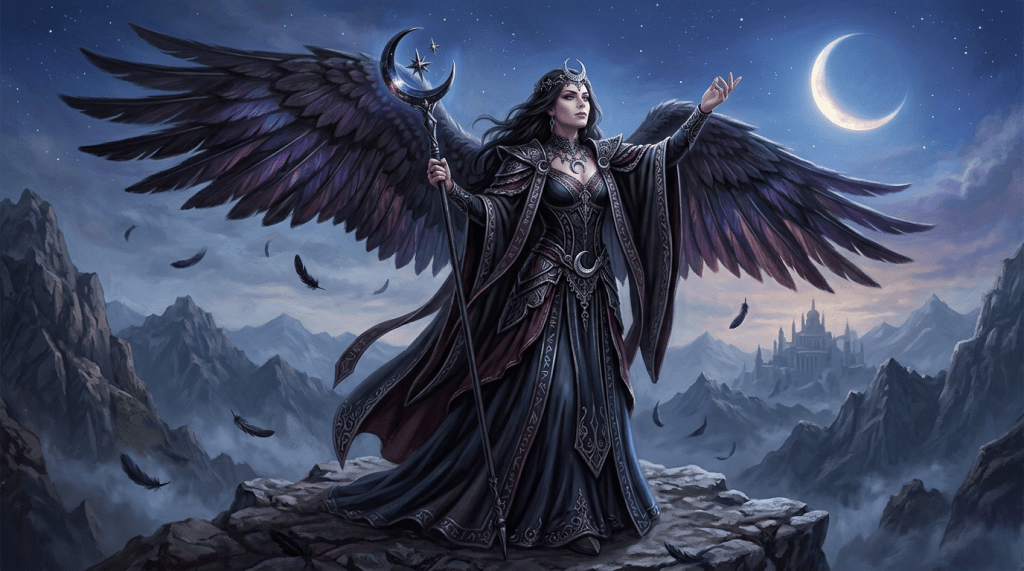
Lilith is one of mythology’s strangest survivors, a figure who began as a minor demon in ancient Mesopotamian belief and grew into one of the most debated women in religious folklore. She appears in fragments across Babylonian incantations, a single verse of the Hebrew Bible, and a medieval Jewish text that gave her the story most people know today. Centuries later, she resurfaced again as a symbol of independence in feminist and occult circles. Few figures show so clearly how a myth can be reshaped by each era that inherits it
Lilith endures because she occupies an unusual space in religious storytelling, a figure defined almost entirely by refusal and by the anxieties she represented to the cultures that feared her. Her transformation from a Mesopotamian night demon into Adam’s defiant first wife, and later into a modern symbol of independence, shows how a single name can carry very different meanings across thousands of years. That layered history makes her one of the more contested figures in religious folklore, with scholars still disagreeing about her earliest form and later interpreters reshaping her to fit their own concerns. Readers curious about how ancient demon lore evolved into medieval legend may want to look further into the Alphabet of Ben Sira itself, where her fullest and strangest story survives.
Lilith’s earliest traces appear in Mesopotamian culture, where texts describe lilitu spirits, night demons blamed for miscarriages, infant deaths, and troubled sleep. These entities were not a single named goddess but a class of dangerous beings invoked in protective amulets and incantation bowls meant to keep them away from mothers and children. The Hebrew Bible mentions Lilith by name only once, in Isaiah 34:14, where she appears briefly among the wild creatures haunting a desolate wasteland. Scholars still debate exactly what the term meant to the prophet’s original audience, since the passage offers no explanation of her nature.
The fuller story familiar today comes from the Alphabet of Ben Sira, a satirical Jewish text likely composed sometime between the 8th and 10th centuries CE. It describes Lilith as Adam’s first wife, formed from the same earth as him rather than from his rib. She refused to accept a subordinate role in their marriage, spoke the sacred name of God, and fled the Garden of Eden rather than submit. According to the tale, she settled by the Red Sea and became the mother of demonic offspring, prompting God to send angels to bring her back. When she refused, she was cast as a threat to newborn children, a role echoing her much older Mesopotamian origins. Kabbalistic writings from the medieval period expanded her story further, casting her as a demonic queen and consort to Samael. In the twentieth century, feminist writers and artists reinterpreted her as a figure of self-determination, a reading that reflects modern values more than ancient belief.
Lilith’s imagery draws on her long association with night, wilderness, and danger to children, though far less material survives about her than about better-documented goddesses. Ancient and medieval sources describe her through a narrow set of recurring images rather than an elaborate visual tradition.
Common Symbols
- Amulets and protective inscriptions: Jewish households historically used amulets inscribed with angelic names to guard infants and mothers against Lilith, reflecting her role as a threat to be warded off rather than worshipped.
- The serpent: Later artistic and literary traditions, including some Renaissance depictions of the Garden of Eden, associate Lilith with the serpent that tempts Eve, though this link is a later embellishment rather than an element of the earliest texts.
Sacred Animals
Owls appear in connection with Lilith largely because some English translations render the Hebrew term in Isaiah 34:14 as “screech owl,” linking her to a bird long associated with night and ill omen in many cultures. This translation choice remains debated among scholars, so the owl connection should be treated as an interpretive tradition rather than settled fact.
Colors
No ancient or medieval source consistently assigns Lilith a specific color, so claims linking her to particular hues reflect modern occult and pop-culture invention rather than historical practice.
Celestial Associations
Unlike deities tied to a specific star or planet, Lilith has no clear celestial association in the ancient sources. A term called “Black Moon Lilith” appears in modern astrology, referring to a point in the moon’s orbit, but this is a contemporary astrological concept rather than an ancient belief about the figure herself.
Lilith’s family connections shift depending on which tradition is telling her story. The Mesopotamian lilitu demons had no fixed genealogy at all, since they were treated as a category of spirit rather than individuals with parents or siblings. The Alphabet of Ben Sira changes this by making her Adam’s first wife, created directly by God from the same soil as Adam himself, which placed her outside the usual family structures of Genesis.
That same text describes her fleeing to the Red Sea, where she is said to have produced demonic children sometimes called the lilin, entities blamed for illness and misfortune in later folk belief. Kabbalistic sources from the medieval period paired her with Samael, a figure associated with evil and destruction, casting the two as a demonic counterpart to Adam and Eve. These relationships vary considerably between texts and time periods, and readers should treat them as separate layers of tradition rather than one continuous family history.

