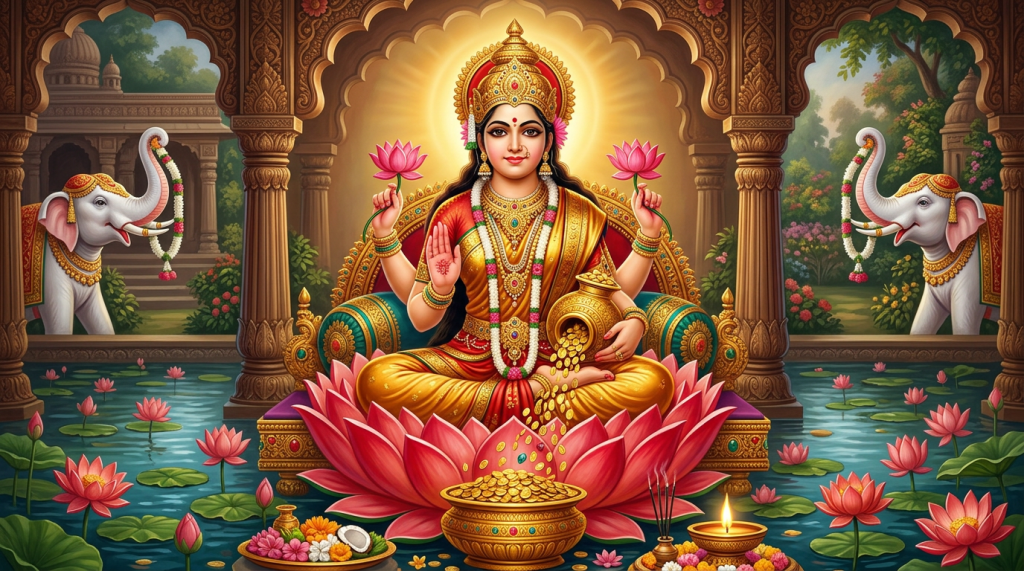
Lakshmi is one of the most widely worshipped deities in Hinduism, honored as the goddess of wealth, prosperity, and good fortune. She appears across thousands of years of Indian religious life, from ancient Vedic hymns to the small clay lamps lit in modern homes during Diwali. For many Hindus, she represents not just money but the broader idea of abundance: health, happiness, and a well-ordered household.
Lakshmi’s staying power comes from how directly she connects to everyday concerns. Wealth, security, and household well-being aren’t abstract ideas to most people, and she gives those concerns a face and a story. Her image sits in homes, shops, and temples across South Asia and the diaspora, and her festival, Diwali, remains one of the most widely celebrated events in the Hindu calendar.
Lakshmi’s origins trace back to the Vedic period, though she takes clearer shape in later Puranic literature, the collection of texts that shaped much of popular Hinduism. One of her best-known myths is the Samudra Manthan, or the churning of the cosmic ocean. In this story, gods and demons work together, using a mountain as a churning rod and a serpent as a rope, to extract the nectar of immortality from the sea. Lakshmi rises from the ocean during this process, fully formed and radiant, and chooses the god Vishnu as her husband. The story positions her as something that emerges from struggle and effort rather than something simply given.
Lakshmi is part of the Tridevi, a trio of major goddesses in Hinduism alongside Saraswati and Parvati. She has taken different forms across mythology, most notably as Sita, wife of Rama, and Radha or Rukmini in connection with Krishna, since Vishnu himself takes different avatars. This layered identity has helped her remain relevant across regional traditions and sects. Today she’s invoked constantly in daily life, from business openings to household prayers, and Diwali, the festival of lights, is largely built around welcoming her into the home.
Lakshmi’s imagery is consistent enough that she’s easy to spot in Hindu art, even for people unfamiliar with the tradition. She’s typically shown with four arms, seated or standing on a blooming lotus, often with gold coins pouring from one of her hands.
Common Symbols
- Lotus flower: represents purity and spiritual growth rising out of muddy, difficult circumstances.
- Gold coins: signal material wealth and generosity, often shown flowing from her palm.
- Four arms: understood to represent the four goals of human life in Hindu thought—dharma (duty), artha (wealth), kama (desire), and moksha (liberation).
Sacred Animals
Owls and elephants appear frequently in her iconography. The owl, Lakshmi’s vahana or vehicle, is associated with the ability to see through darkness, while elephants, often shown flanking her with raised trunks, are tied to royal power and rainfall, which in agricultural societies meant prosperity.
Colors
Red and gold dominate her depictions. Red connects to marital auspiciousness and activity, while gold reflects wealth itself.
Celestial Associations
Lakshmi doesn’t have a strong direct link to a specific celestial body the way some deities do, though she’s sometimes loosely associated with the full moon, tied to themes of completeness and abundance.
Lakshmi is the wife of Vishnu, one of Hinduism’s principal deities and the preserver within the Trimurti, the triad that also includes Brahma and Shiva. Their relationship is often described as a model for marital devotion, and Lakshmi is understood to accompany Vishnu through his various avatars in different forms.
Accounts of her origin vary depending on the source. In the Samudra Manthan story, she emerges from the churned ocean without conventional parents, born fully grown from the cosmic waters. Other, older traditions describe her as a daughter of the sage Bhrigu. She’s sometimes listed among the offspring of Daksha, an early progenitor figure in Hindu cosmology. These differences aren’t treated as contradictions so much as separate strands within a large and varied mythological tradition. She’s commonly grouped with Saraswati and Parvati as one of three great goddesses, though the exact nature of their relationship to one another differs across texts and regional practice.

