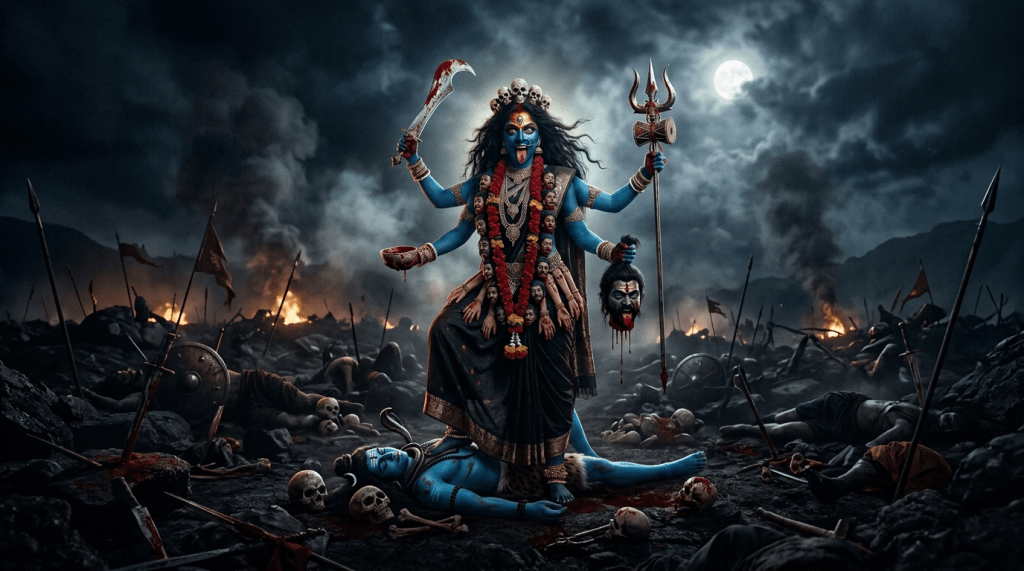
Kali is one of Hinduism’s most striking deities, a goddess associated with time, death, and destruction who is also revered as a fierce protector and a path to spiritual freedom. She appears in Hindu art draped in a garland of skulls, tongue extended, sword raised over a battlefield of demons. That imagery has made her a source of fascination and, at times, misunderstanding outside India. Within Hindu tradition, she represents something far more layered: the force that clears away illusion so truth can stand in its place.
Kali endures because she confronts something most religious traditions try to soften: the reality that destruction and death are built into the fabric of existence. Rather than asking worshippers to look away from that truth, her mythology asks them to face it directly and find liberation on the other side. That combination of terror and tenderness, destroyer and mother, has kept her central to Hindu devotional life for well over a thousand years. Readers who want to understand how a goddess of death became one of Hinduism’s most beloved figures of maternal love may want to look further into her role within Bengali Shaktism and the devotional poetry written in her honor.
Kali’s roots trace back to early Hindu texts, though she becomes especially prominent in later devotional literature such as the Devi Mahatmya, composed around the 5th or 6th century CE. She is closely tied to Durga, another warrior goddess, and in several myths emerges directly from Durga’s anger during battle. The most famous of these stories describes the demon Raktabija, whose blood spawned a new demon with every drop that touched the ground. Kali defeated him by drinking his blood before it could fall, then danced across the battlefield in a fury so intense that the god Shiva laid himself beneath her feet to calm her rage.
That myth captures much of what Kali represents in Hindu thought. She embodies kala, the Sanskrit word for time, and by extension the force that consumes all things and eventually ends them. Rather than treating this as purely negative, many Hindu traditions frame her as a goddess of liberation, since the destruction of ego and illusion is considered a necessary step toward spiritual enlightenment. Her worship grew especially strong in Bengal, where she became a central deity for the Shakta tradition, which reveres the divine feminine as the supreme power underlying the universe. Ramakrishna, the 19th-century mystic, helped popularize her worship further through his own intense devotion to her as a loving mother figure rather than a purely fearsome one.
Kali’s imagery is dense with meaning, and much of it has been misread outside Hindu contexts as purely violent or sinister. Within Hindu theology, each element of her appearance carries a specific philosophical message about time, ego, and liberation.
Common Symbols
- The garland of skulls or severed heads: Often numbered at fifty, representing the letters of the Sanskrit alphabet and the idea that Kali is the source of all sound and language.
- The extended tongue: Interpreted in various ways, including as an expression of shock at her own destructive power or as a symbol of consuming and transcending the ego.
- The sword and severed head she carries: Represent the destruction of ignorance and the false sense of a separate self.
Sacred Colors
Black or deep blue is her most common association, representing the vastness of time and space that contains all things within it. Red also appears frequently in her imagery, tied to both blood and life force.
Depictions
Kali is often shown standing or dancing on the body of Shiva, a pose that carries deep philosophical weight. Some traditions interpret this as her power being tempered by Shiva’s stillness, while others read it as a statement that consciousness (Shiva) and dynamic energy (Kali) depend on each other to sustain the universe.
Celestial Associations
Kali does not have a strong tradition of celestial or planetary association in the way some other deities do. Her symbolism centers on time itself rather than any particular star or planet, which fits her role as an embodiment of kala.
Kali’s place in the Hindu family of deities varies by tradition and text, which is common for a goddess worshipped across such a wide span of Indian religious history. In many accounts she emerges from Durga rather than being born through conventional parentage, making her origin more a manifestation of divine energy than a birth story in the usual sense. Some Shakta traditions instead describe her as the fundamental, formless source from which all other gods and goddesses arise, including Durga herself.
Her connection to Shiva is the most consistently told relationship in her mythology, though the two are described differently depending on the text and regional tradition. In some stories they are portrayed as consorts, while in others their relationship reflects a philosophical pairing of consciousness and energy rather than a marriage in the human sense. Kali is also grouped among the Mahavidyas, a set of ten fierce goddess forms in Tantric Hinduism, where she is typically listed first and considered the source from which the others emerge.
 LOVE + TEA + SOUL