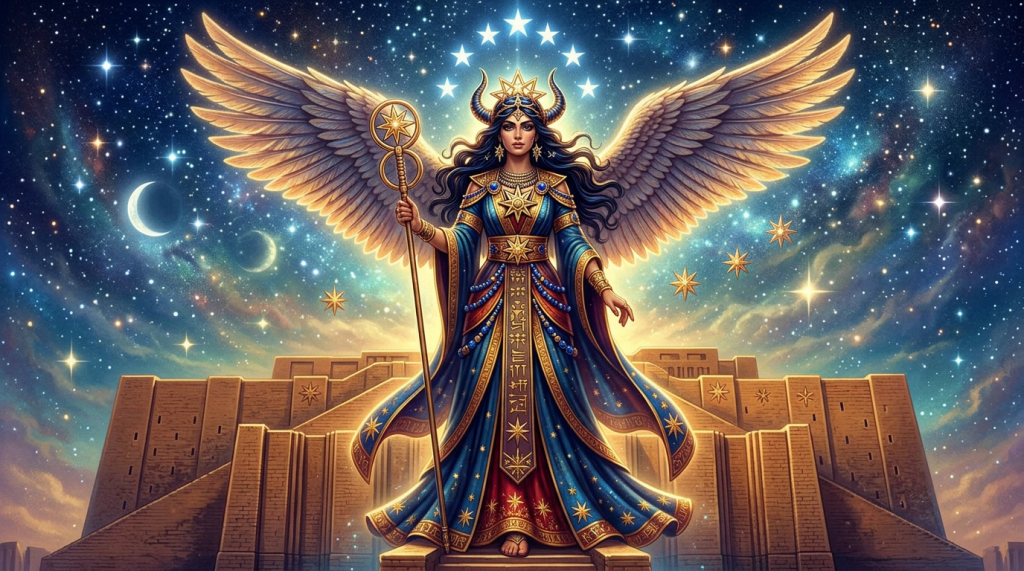
Inanna was the Sumerian goddess of love, fertility, and war, later worshipped by the Akkadians, Babylonians, and Assyrians under the name Ishtar. She ranks among the oldest deities on record, with hymns and temple inscriptions describing her thousands of years before the Greek and Roman pantheons took shape. Her personality set her apart from many goddesses of the ancient world: she claimed both the bedroom and the battlefield as her territory, and Mesopotamian texts treat that combination as a source of power rather than contradiction. Scholars still study her myths for what they reveal about how early city-states understood desire, ambition, and the risks of both.
Inanna endures in the historical record because her mythology captures a genuinely complicated figure: a goddess who could inspire devotion and fear in equal measure, unwilling to be confined to a single role. Her willingness to risk everything in the underworld, and the price she paid for it, gave Mesopotamian worshippers a goddess whose story acknowledged real loss alongside real power. That complexity carried forward as her worship spread and transformed into the cult of Ishtar, shaping religious practice across the ancient Near East for centuries. Readers curious about how her myths shaped later Near Eastern religion may want to explore “The Descent of Inanna” in full, one of the oldest surviving stories of death and return in human literature.
Inanna’s worship began in Sumer sometime before 3000 BCE, centered in the city of Uruk, where she served as patron deity. As Mesopotamian political power shifted from Sumerian to Akkadian city-states, she merged with the Akkadian goddess Ishtar, and her cult continued under that name through the Babylonian and Assyrian periods. Her domains included sexual love, fertility, and physical beauty, but she also governed warfare and held authority over the movements of armies, a pairing that set her apart from most other love goddesses in the ancient Near East.
Her most famous myth, “The Descent of Inanna,” describes her journey into the underworld to confront her sister Ereshkigal, ruler of the dead. Inanna is stripped of her power and clothing at each of the underworld’s seven gates, dies there, and is eventually restored to life through the intervention of other gods, though at the cost of sending her husband Dumuzi to take her place for part of the year. The story is often read as an early seasonal myth tied to agricultural cycles, and it left a lasting mark on later Near Eastern religion. Some scholars trace echoes of her death-and-return pattern in later myths from the region, including elements of the Greek story of Persephone, though the connection remains debated rather than settled.
Inanna’s imagery reflected her dual nature as a goddess of both passion and violence. Temple carvings, cylinder seals, and hymns used a fairly consistent set of emblems to mark her presence, and later Ishtar worship largely preserved these same symbols.
Common Symbols
- The eight-pointed star: Her most recognizable emblem, likely representing the planet Venus, appears on seals, boundary stones, and temple walls throughout Mesopotamia.
- The rosette: A flower-like design frequently carved above temple doorways and on royal garments associated with her cult.
- Bundled reeds: An ancient symbol tied to Inanna’s earliest Sumerian worship, thought to represent doorposts or storehouses under her protection.
Sacred Animals
The lion appears constantly in Inanna and Ishtar’s iconography, often shown at her side or serving as her mount, reflecting her role as a goddess of war and fearlessness. Doves also appear in some depictions, connecting her to the gentler, love-focused side of her character.
Colors
Surviving sources do not establish a single fixed color for Inanna, so later associations should be treated as later tradition rather than confirmed ancient practice.
Celestial Associations
Inanna was closely identified with the planet Venus, tracked by Mesopotamian astronomers as both a morning and evening star. This dual appearance in the sky mirrored her dual nature, and Babylonian astronomical records treated Venus’s movements as directly tied to her presence and moods.
Inanna’s parentage differs across Sumerian sources, with some texts naming the sky god An as her father and others describing her as a daughter of the moon god Nanna and his wife Ningal. This kind of variation was common in Mesopotamian religion, where different city-states maintained their own priesthoods and local traditions about the gods. She is frequently associated with Utu, the sun god, described in various texts as her brother and occasional protector during her more dangerous exploits.
Her marriage to the shepherd god Dumuzi (later Tammuz in Akkadian tradition) forms the emotional center of much of her mythology, including the courtship poetry that survives from Sumerian temple archives and the underworld myth that ends with his death. Her sister Ereshkigal, ruler of the underworld, appears as her mythological rival in the descent myth, and the tension between the two sisters is often read as a symbolic contrast between the world of the living and the realm of the dead. Unlike many goddesses of the ancient world, Inanna is rarely described as a mother figure in surviving myths, which further sets her apart within the Mesopotamian pantheon.

