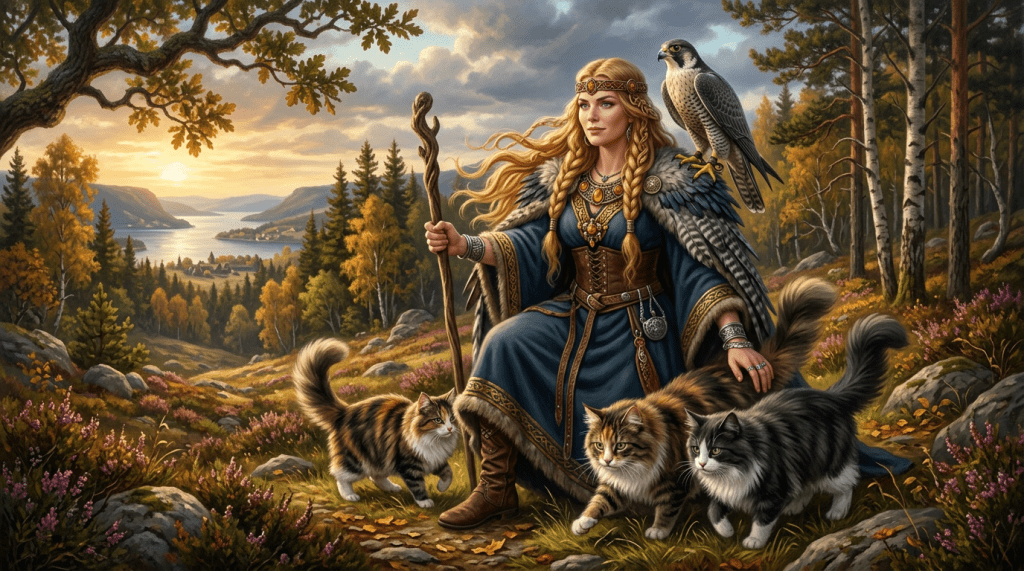
Freyja stands among the most powerful figures in Norse mythology, ruling over love, fertility, beauty, war, and death all at once. She belongs to the Vanir, a group of gods tied to fertility and prosperity, though she later joined the more widely worshipped Aesir. Ancient sources describe her riding into battle to claim half the slain warriors for her own hall, a detail that surprises many people who know her only as a goddess of romance.
Freyja endures as one of the richest figures in Norse mythology precisely because she resists simple categorization. She governs love and death, beauty and battle, magic and material wealth, often within the same story. Her cats, her falcon cloak, and her golden tears remain recognizable symbols centuries after her worship faded, and her influence on later folklore and popular culture continues to grow.
Freyja comes from Norse mythology, practiced by the Scandinavian peoples before Christianization. She belongs to the Vanir, the fertility gods who fought the Aesir before eventually joining them, according to the Prose Edda. Once integrated into the wider pantheon, she became one of the most prominent goddesses in the mythology, associated with love, beauty, fertility, gold, war, and seiðr, a form of Norse magic tied to prophecy and fate. Scholars believe she taught this practice to Odin himself.
Several myths highlight her importance. In one story, she weeps tears of gold searching for her missing husband, Óðr, linking her permanently to wealth and longing. In another, she acquires the necklace Brísingamen from four dwarves, an object so precious it later becomes a source of conflict among the gods. She also commands Fólkvangr, her own field in the afterlife, where she receives half of those who die in battle while Odin receives the other half in Valhalla. This role placed her on equal footing with Odin in matters of war and death, a detail often overlooked in modern retellings that focus only on her connection to love. Her worship persisted long after many other Norse traditions faded, and her name survives today in the English word “Friday,” Frigg’s day in some interpretations but widely tied to Freyja in Scandinavian sources.
Freyja’s symbolism draws from both her gentler domains and her more fearsome ones. Norse sources connect her to specific objects, animals, and natural forces that reflect her dual nature as a goddess of love and a goddess of war.
Common Symbols
- Brísingamen: Her famous necklace, representing beauty, wealth, and the lengths she went to acquire something she desired.
- Falcon cloak: A feathered cloak that let her transform into a falcon and fly between worlds, symbolizing freedom and magical power.
- Gold: Tied to the myth of her golden tears, gold represents both her grief and her association with wealth.
Sacred Animals
Cats hold a special place in her mythology. Two large cats pulled her chariot, a detail recorded in the Prose Edda, and this association has made cats a lasting symbol of her presence. Boars also appear in connection with her; her lover Óttar was said to transform into one, and the boar Hildisvíni accompanied her in some tales.
Colors
Ancient sources do not provide reliable evidence for colors specifically tied to Freyja, so this category is best left unaddressed rather than filled with modern assumptions.
Celestial Associations
Some later folklore links Freyja to the planet Venus, likely due to her association with love and beauty, though this connection appears more in modern interpretation than in surviving Old Norse texts.
Freyja’s family ties her closely to the Vanir gods. Her father is Njörðr, god of the sea and seafaring, and her mother is not named consistently across sources, though some traditions suggest she may have been Njörðr’s own sister. Her twin brother, Freyr, is another major Vanir deity associated with prosperity, peace, and good harvests.
Freyja’s husband, Óðr, disappears for long stretches, prompting her search and her golden tears; some scholars have proposed that Óðr may represent another aspect of Odin himself, though this remains debated. Together they had two daughters, Hnoss and Gersemi, whose names both mean “treasure,” fitting for children of a goddess linked to wealth and beauty. Norse sources also describe various lovers and suitors throughout her stories, reflecting her strong association with desire and romantic pursuit.
 LOVE + TEA + SOUL