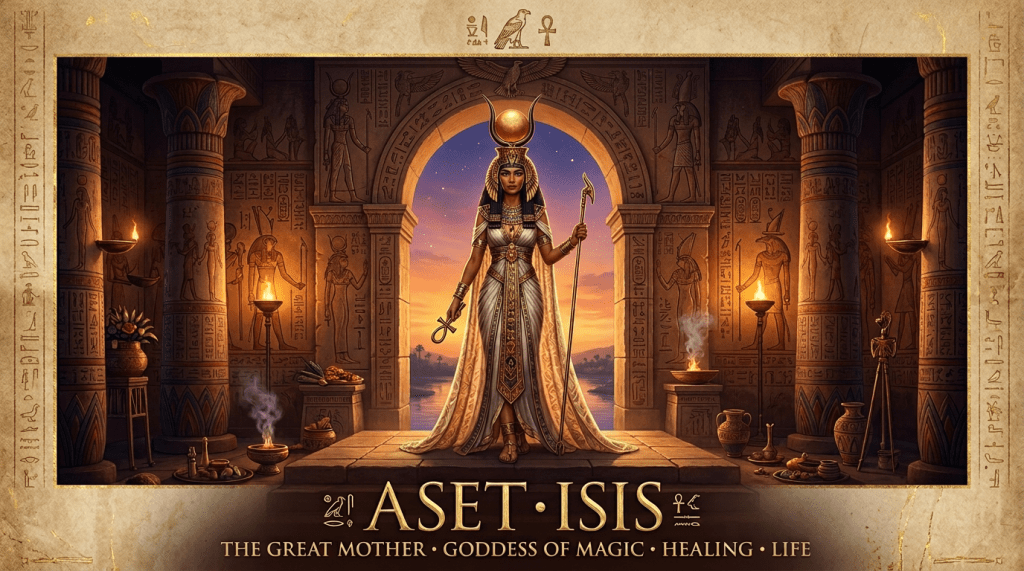
Aset, better known by her Greek name Isis, ranks among the most enduring deities of the ancient world. Worshipped in Egypt for over three thousand years, she was a goddess of magic, motherhood, and resurrection whose cult eventually spread across the Roman Empire. Her story is inseparable from one of Egypt’s most famous myths: the murder and rebirth of her husband Osiris. Even today, her image and symbolism echo through later religious art and popular culture.
Aset’s staying power comes from how directly her mythology speaks to universal human experiences: loss, devotion, and the desire to protect one’s family against overwhelming odds. She offered ancient worshippers a goddess who used intelligence and persistence rather than brute strength to overcome tragedy, which helps explain why her cult spread so far beyond Egypt’s borders. Her image as the grieving yet resourceful mother left a mark on religious art that outlasted the Egyptian civilization that first gave her form. For readers curious about how a single goddess could bridge Egyptian, Greek, and Roman religious worlds, the full Osiris myth is worth exploring in greater depth.
Aset emerged in Egyptian religion sometime before 2400 BCE, appearing in the Pyramid Texts as a protector of the dead pharaoh. She belonged to the Ennead of Heliopolis, a group of nine deities central to Egyptian cosmology, and her defining role was tied to the Osiris myth. According to the story, her husband Osiris was murdered by his jealous brother Set, who dismembered the body and scattered the pieces. Aset searched Egypt to recover them, used her magical skill to reassemble and revive Osiris long enough to conceive their son Horus, then raised Horus in secret until he was strong enough to claim his father’s throne.
That myth gave Aset her core identity as a goddess of magic, healing, and fierce maternal protection. Egyptians called on her in medical spells and childbirth rituals, believing her magic could cure snakebites and other ailments. Her influence only grew over time. By the Ptolemaic and Roman periods, her worship had spread from Egypt into Greece, Rome, and beyond, making her one of the few Egyptian deities to gain a truly international following. Temples to Isis stood as far away as Britain, and her cult persisted well into the early centuries of Christianity, with some scholars noting visual parallels between later images of Isis nursing Horus and early depictions of the Madonna and Child.
Aset’s imagery drew heavily on both her role as a devoted wife and mother and her reputation as a formidable magician. Artists and priests represented her through a consistent set of symbols that reinforced these themes across temple carvings, amulets, and funerary art.
Common Symbols
- The throne hieroglyph: Worn as a headdress, this symbol may represent her name and her connection to kingship, since pharaohs were sometimes described as sitting on “the throne of Isis.”
- The tyet knot: Often called the “Isis knot,” this symbol resembles an ankh with folded arms and appears frequently in amulets meant to offer protection.
- Outstretched wings: Isis was often shown as a winged figure sheltering Osiris or Horus, symbolizing her protective magic.
Sacred Animals
The kite, a bird of prey, held special significance because myths described Isis transforming into one to fan life back into Osiris’s body with her wings. Cobras also appear in her iconography, tying her to broader Egyptian ideas about protective and royal power.
Colors
Ancient sources do not consistently assign her a single sacred color, so later claims linking her to particular hues should be treated cautiously.
Celestial Associations
Isis was linked to the star Sirius, called Sopdet by the Egyptians. Its heliacal rising each year lined up with the annual flooding of the Nile, connecting her to the cycle that Egyptian agriculture depended on.
Aset was the daughter of the earth god Geb and the sky goddess Nut, making her part of one of Egyptian mythology’s central family groups. She had three siblings: Osiris, who became her husband; Set, who murdered Osiris and features as her mythological adversary; and Nephthys, who is sometimes portrayed as her close companion in mourning and magic despite being married to Set.
Her marriage to Osiris is the backbone of her mythology, and their son Horus became one of Egypt’s most important gods, closely tied to the living pharaoh. Some traditions describe Isis assisting or interacting with other deities, such as Thoth, who helped her with magical knowledge, though these relationships vary by source and time period rather than forming a fixed structure.

